Ó£ÌÒÊÓÆµ

Fast Food - Page 201

Surprising origins of the 10 biggest chain restaurants
March 20, 2018

Surprising origins of the 10 biggest chain restaurants

It’s not easy to run a restaurant. It’s even more difficult to run a chain restaurant. For one, you need to serve food that people will want to eat, all across the region, country, or world. Then you need to keep the menu fresh and up-to-date, all while making sure that every single dish in every single location looks and tastes exactly the same. And after all of that’s been done, you need to launch marketing and advertising campaigns to fill the seats, and figure out what’s going wrong if they’re not getting filled. To repeat, it’s not easy to run a successful chain restaurant. Chain restaurants as we know them today only came about within the past 30 or so years, largely because that genre of restaurant, called fast casual, is only about that old. There were plenty of hamburger chains and diner chains dating back to the 1950s, but the whole concept of going to a casual restaurant with your family, having a beer and ordering inexpensive food that makes everyone happy, and leaving with a doggie bag is still remarkably new. In fact, when Larry Lavine opened the first Chili’s in 1975 in Dallas, people lined up around the block on a daily basis just to eat a bowl of chili and drink a margarita. In many cases, the origins of today’s most popular chain restaurants aren’t exactly what you might expect. Many of them had different names when they were founded, as well as different menus and concepts. With the exception of Olive Garden, which was invented by General Mills as opposed to a single lucky entrepreneur, most of the big chains got their start when someone opened up a restaurant that just happened to do really, really well. And if it happened to fall into that new style of fast casual dining, wealthy investors were waiting around every corner during the '70s and '80s to take advantage of this newest dining trend. Once a chain restaurant is well-funded and its concept and menu are fully in place, it’s amazing how quickly it can spread. Panera Bread, one of the youngest major chains, only got its start 20 years ago, but today there are more than 1,600 units and it’s rapidly growing. Whether it’s an Australian-themed steakhouse, an inexpensive wing joint, or a New England-style seafood restaurant, these chains are known and patronized by millions and millions of Americans, and they all have really interesting backstories.  

America's most expensive diner food
Ridiculous restaurant commercials from the 1980s
March 20, 2018

Ridiculous restaurant commercials from the 1980s

Unless you’re a chain restaurant with a big marketing budget, odds are you’re not going to be doing too much in the way of television advertising these days. Commercials for non-chain restaurants, for one reason or another, always come across as dated and a bit tacky, because — honestly — how many ways can you say, "Come eat at my restaurant, it looks nice and the steak is good!"? From red sauce joints all the way up to high-end steakhouses, modern restaurant commercials tend to be a staid, low-res affair, with upbeat jazz, a voice-over, maybe some smiling patrons, close-ups of the food, and a snappy motto. But once upon a time — in the 1980s, to be exact — restaurant commercials were an art form. Back in those halcyon, pre-Internet days, when airtime was cheap and people actually tuned into public access channels, the airwaves were flooded with restaurants strutting their stuff, trying to attract as many customers as possible in any way possible. And in the flashy 1980s, nothing succeeded quite like a big, flashy commercial (or a big, flashy anything, for that matter). While independent restaurants are certainly guilty of going a bit over the top (for example, a commercial for Brooklyn’s Roll-N-Roaster is so outrageous that it’s entered into the New York pop culture lexicon and is still airing more than 30 years later), chains weren’t exempt from getting in on the ridiculousness either. There’s one from Bob’s Big Boy that hits all the essential notes of the '80s: close-ups of questionably appealing-looking food, children smiling perhaps a bit too broadly, and a vaguely creepy mascot. But one from A&W takes things in a slightly more unintentionally menacing direction, with a giant bear conducting an invisible band, someone tearing a whole head of lettuce in half, and nonexistent adjectives like "LOTSY," "NUMMY," and "TREATY" flashing across the screen, all against a black background. The bear makes a brief reappearance at the end of the commercial, playing a tuba. It's safe to say a lot of weird and awkward things happened during the 1980s, these commercials included.

How to make Taco Bell’s Crunchwrap Supreme at home
March 20, 2018

How to make Taco Bell’s Crunchwrap Supreme at home

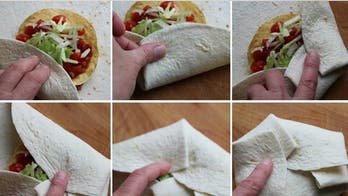
Nothing sums up the deliciousness of a Taco Bell Crunchwrap Supreme more concisely than the love letter to it on the daily humor website McSweeney’s. All of the Crunchwrap’s beauty is perfectly summarized in that piece: the convenience of not having to choose between a soft or crunchy tortilla, the patches of sour cream randomly placed throughout it, and a creamy, indulgent nacho cheese sauce that is the ying to the meat’s yang. And it’s all wrapped together in a soft tortilla shell that makes it easy to enjoy one-handed without making a mess.   As one of the most successful products in the history of fast food (until that Doritos Locos Tacos came around), the Crunchwrap Supreme is loved by many because of its south-of-the-border flavors and ingenuity in design. Because it's shaped like a hexagon, the idea of calling it a "Mexagon" was once thrown around, but in the end the three words that perfectly describe it became its name: it’s got crunch, it’s a wrap, and it’s supreme in flavor. There are many reasons to make a Crunchwrap Supreme at home. It once was a limited-time item on Taco Bell’s menu, and the fear of ever losing it again is still something we hold on to almost every single day. At 540 calories and with 21 grams of fat, it’s no walk in the park for nutrition’s sake, but by making it at home you have more control over what is going in the dish. And lastly, it’s a fast-food item, and there are so many of us out there who can appreciate good taste, but aren’t always willing to line up at the drive-thru for it. And so it is for these reasons and probably even more that we’ve decided to take on the task of making a Crunchwrap Supreme at home. While the Irvine, Calif., company was unwilling to help us with our endeavor, we think we have been able to create a do-it-yourself recipe successfully for the home cook. We examined every aspect of the menu item, from the consistency of the meat and the spices used to flavor it to the wrap’s exact construction so that it upheld all of the same tastes, flavors, and ease-of-eating qualities that the store-bought one has. We even added a few additions of our own (like enjoying it with taco sauce), to make it special, unique, and — most importantly — homemade. They can’t blame us for copying them; they’re the ones who told us to think outside the box (or is it bun?).

America's best hot dogs
March 20, 2018

America's best hot dogs

The hot dog is one of the few foods that’s nearly impossible to screw up. You heat it through, tuck it into a bun, squirt on some mustard, and call it lunch. But there’s a big difference between not screwing something up and turning it into a paradigm-shifting, transcendental dining experience. And there are lots of hot dog stands, restaurants, and drive-ins out there that have the power to change your life. The perennial grill mate to hamburgers, the hot dog sometimes gets the short end of the stick, charring at the back of the grill while juicy burgers are snatched up as soon as they hit the right temperature. But there’s a science, if not an art form, behind constructing the perfect hot-dog-eating experience. That experience was introduced more than 100 years ago, when German immigrants first brought over their frankfurters and started selling them on the cheap at amusement centers like Coney Island, arguably ground zero for American hot dog consumption. Charles Feltman is widely considered to be the first person to have applied hot dog to bun, in order to avoid needing to supply plates and silverware to customers at his sprawling Coney Island restaurant. Employee Nathan Handwerker opened his own hot dog stand a few blocks away in 1916 and sold them for less than Feltman, and became wildly popular (and remains so to this day). The hot dog diaspora then began to take on a life of its own, as people began developing their own spice mixes and making their own hot dogs, and every region and group of people soon put its unique stamp on the snack. Greek immigrants in Michigan concocted a cinnamon-rich beef chili that came to be known as Coney sauce, but it has nothing to do with Coney Island, while ‘michigans’ are big in Upstate New York but have nothing to do with the state. In Chicago they top all-beef dogs with mustard, fresh tomatoes, onions, sport peppers, bright green relish, dill pickles, and celery salt. Spicy Texas Red Hots are popular in New Jersey, but not in Texas, and the uncured, unsmoked White Hot is popular in upstate New York. And the regional variations go on and on. According to a recent study by GrubHub, the country’s most popular hot dog topping is cheese, followed by chili, mustard, onion, and Chicago-style. Ketchup is further down on the list, and, surprisingly, sauerkraut is down towards the bottom.   On our quest to find America’s best hot dogs, we kept an eye out for drive-ins, restaurants, and roadside stands with a definitive style of hot dog and topping, one which embodies not only the region’s quirks but the particular tastes and culinary traditions of its people. We judged these hot dogs based on several criteria: the quality of the ingredients (sourcing the franks from well-known regional producers and using fresh-chopped onions, for example), the entire hot dog-eating experience, from driving up to placing your order to taking that first bite, as well as reputation among professional critics and online reviewers. In order to be included in our list, the vendor needed to have a trademark dog, with toppings that are unique and renowned. For example, Ben’s Chili Bowl in Washington, D.C. doesn’t just have a trademark frank (the half-smoke), it has a trademark topping (chili), is well-regarded by locals and professional eaters alike, and eating there is a memorable experience unto itself. For those reasons, it’s high on our list. Sadly, there were some popular favorites that didn’t make the cut. While Lafayette Coney Island in Detroit ranks high, its modernized neighbor, American Coney Island, didn’t, because it lost much of its charm in the renovation. And while the pretzel dog at chain Auntie Anne’s has its loyal devotees, the experience isn’t exactly sublime. Our list runs the gamut from ancient stands that have been serving the same exact product day in and day out for decades to gastropubs putting their unique stamp on the hot dog to a place where people wait in line for more than an hour for one topped with foie gras. There’s one constant thread between them, though: they’re the country’s best.

America's top tater tots
March 20, 2018

America's top tater tots

There’s something magical about the humble Tater Tot. Some might even argue that it’s the perfect food: bite-size, salty, crispy, crunchy on the outside, soft on the inside, greasy but not overly oily, and a great vessel for just about any topping. Its abundant nooks and crannies allow for nearly limitless surface area (aka more crunch) and it boasts a pillowy interior that french fries can only hope to emulate — let’s just say there are many reasons why it’s one of our favorite childhood foods. "Tater Tot" is actually a registered trademark of Ore-Ida, the company that invented them in 1953. Founders F. Nephi and Golden Grigg (great names) found themselves with an excess of potato scraps after making french fries, and were sick of selling them off for a pittance as animal feed. So they chopped them up, added in some flour and other seasonings, and then sent the whole mess through an extruder and into the deep-fryer. And a legend was born. Tots straight out of the deep-fryer are certainly a wonder to behold (as many a cafeteria worker can attest), but one thing that makes tots great is their versatility. They can be eaten plain, sure, but why not top them with, say, pulled pork? In today’s no-holds-barred, the-fattier-the-better foodiverse, tots have taken off, most likely because not only does the humble processed spud serve as a great vessel for all types of toppings, it also takes us back to a simpler time, when all we needed to be happy was something deep-fried and delicious (come to think of it, that still applies). Recently, tots have been making their way onto menus, and in a big way. Plenty of bars and restaurants are topping their tots with some unbelievable stuff, and even high-end places like Bar Boulud in New York City and The Aviary in Chicago offer highbrow versions of this lowbrow treat. We’ve tracked down the best tots in the country, from pub grub utopia to fine dining whimsy, and ranked them accordingly. While some are made in-house, others are simply fried to perfection and topped with something great. The main criteria? All these tots hit that spot that only the perfect tot can hit. So loosen your belt, and read on for our list of the country's top tots.

Top 10 creepiest food mascots of all time
World’s strangest McDonald's commercials
March 20, 2018

World’s strangest McDonald's commercials

While we're not positive that McDonald's is the first place you should visit when traveling internationally, if you did, you'd see some variations on the familiar burger and fries routine, reflecting a location's culinary traditions. Some offerings don't sound half bad, like Nicaragua's Mango Pie — their variation of our apple pie — and the Paneer Wrap in India, but among the more unusual offerings are Russia's McShrimps, Japan's Bacon Potato Pie, Turkey's McTurco with lamb meat, China's Chicken McMuffin, and Hong Kong's Rice Fantastic, a burger between two rice patties. And just as the menus vary around the world, so do McDonald's television commercials. McDonald's commercials in the United States have long been associated with energetic people enthusiastically crowding into a booth, happily devouring their paper-covered Big Mac. The tone is upbeat, the kids are wholesome, and everyone is thrilled to be under the bright McDonald's lights. We've been treated to jingles ranging from "We do it all for you" to "I'm lovin' it" over the years; we've even been assured that we deserve a break today. Even for those who don’t eat there, McDonald's advertising has made its way into our subconscious. The fast-food giant has trotted out beloved characters, most notably their red-haired mascot Ronald McDonald, for kids to grow attached to and further promote their family-oriented advertising. Sure, many of us think clowns are really creepy, but... well, wait — in McDonald's first TV spot, circa 1963, featuring Ronald, he really is creepy. He doesn't look much like the Ronald we've come to know, but has a more patched-together scarecrow look, with hay-like hair, a paper cup for a nose, and a large tray on his head. (The role was originated by Willard Scott, long before he became the TODAY Show's weather man.) Ronald has had many makeovers since those days, but has long since settled on the basic uniform of a yellow jumpsuit and red-striped socks. This character set the tone for the family-focused ads that we've become familiar with over the years. However, there is a whole other world of McDonald's advertising, several worlds in fact. Although McDonald's started in the United States in the 1940s and has been a fast-food standby ever since, it now has restaurants in 119 countries. And all those folks in all those countries need to be advertised to! Surprisingly, McDonald's doesn't always stick with the happy-go-lucky, cramming-food-into-your-mouth advertising we're accustomed to in the U.S. While some of the ads employ humor, certainly, and many do evoke an upbeat mood, it seems that other countries are not afraid to go off-theme and try different methods of getting a viewer's attention. A little darker, a little sexier, a little more offbeat — these commercials are not quite what you may expect.